R-Panel & Exposed-Fastener Metal Roofing in Round Rock
R-panel and corrugated roofing is the most affordable way to put metal over your building — typically $9 to $14 per square foot installed. Panels are screwed down through the face, which makes installation fast and cheap. The trade-off is those exposed fasteners: they're the part that needs attention down the road.
Where does this make sense in Round Rock?
Mostly on the things that aren't the house. Round Rock still has a lot of ground east of I-35 and out past the city limits that has never been subdivided — shops, workshops, detached garages, barns and equipment cover on Blackland Prairie acreage. R-panel is the honest answer for those buildings: it goes on fast, it costs a fraction of standing seam, and nobody's HOA has an opinion about the roof on a hay barn.
On a house inside a Round Rock subdivision it's a harder sell, and we'd usually steer you elsewhere. Exposed fasteners mean visible screws in rows across the roof, which most architectural review committees here will not pass, and the washers need attention around the 10 to 15 year mark. If budget is the constraint on a home, metal shingles get you a conventional look without that maintenance clock.
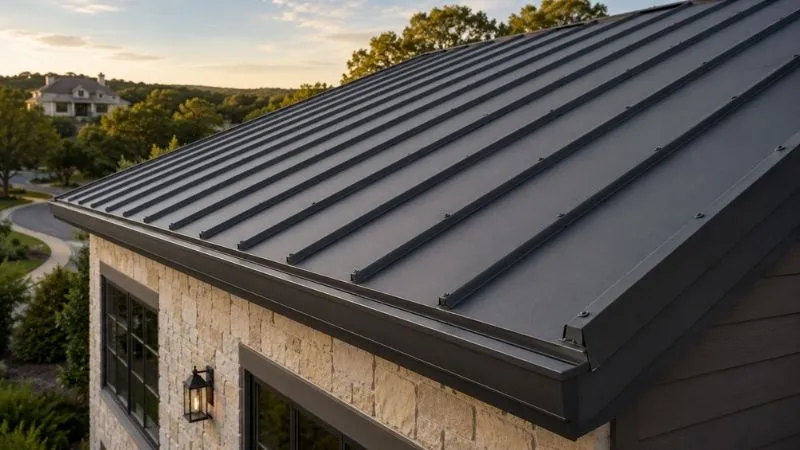
What is an exposed-fastener metal roof?
Exposed-fastener panels — R-panel, PBR, corrugated, and similar profiles — are long metal sheets fastened directly through the surface into the deck or purlins below. You can see the rows of screws across the roof; that's the defining feature. Because installation is straightforward and material costs are low, it's the least expensive metal system available.
Where does it make the most sense?
- Barns, shops, and outbuildings — the classic use, and hard to beat on price
- Detached garages and covered porches
- Rural and acreage properties where the look fits the setting
- Budget-driven residential projects where metal is the goal but standing seam is out of reach
- Low-slope agricultural and light commercial buildings
What profiles are available?
| Profile | Typical use |
|---|---|
| R-panel (PBR panel) | The Texas workhorse. Wide ribs, strong spans, common on homes, shops, and barns. |
| Corrugated | Classic wavy profile. Often chosen for a rustic or agricultural look. |
| U-panel | Similar to R-panel with a different rib spacing and profile. |
| Ag panel | Economy profile built for barns, sheds, and outbuildings. |
The honest trade-off: exposed fasteners
We'd rather tell you this up front than have you discover it in year twelve. Every screw on an exposed-fastener roof passes through the weather surface, sealed by a small rubber washer. Those washers are the weak point — Texas heat, UV, and thermal cycling dry them out, and screws can loosen as panels expand and contract. Somewhere around 10 to 15 years, most of these roofs need fasteners inspected, tightened, or replaced.
That's a manageable maintenance item, not a defect — but it's the reason standing seam costs more. Standing seam hides its fasteners under the seams, so there's nothing penetrating the surface to fail. If you're roofing a house you plan to keep for decades, that difference usually justifies the higher price. Compare the costs here.
How much does it cost?
Expect roughly $9 to $14 per square foot installed in Central Texas. Simple rectangular roofs — barns, shops, garages — sit at the low end. Residential roofs with valleys, dormers, and complex flashing run higher. Tear-off of an existing roof adds to the total.
R-panel FAQs
How long does an exposed-fastener metal roof last?
How much does an R-panel roof cost in Round Rock?
Do exposed-fastener roofs leak?
Is R-panel a good choice for a house?
Ready for a straight answer on your roof?
Call for a free inspection — we'll take a look, walk you through your options, and there's no pressure either way.
Call (737) 320-3400